By Dr. Krystyn Moon
The double burden of Blackness and womanhood often obscured the complexities of property ownership in Jim Crow Virginia. As a civil right, property ownership expanded to all Black people with the abolition of slavery and the federal protections codified in the 14th Amendment. Even Dylan Pennigroth has recently argued that former Confederates recognized that free people had the right to buy and sell land. For African American women and men, the ability to own property was integral to their understandings of freedom and equality. Many formerly enslaved families pooled wages to purchase land for the first time after the war.[1]
Over the course of the nineteenth century, state legislatures also expanded property rights for women, finally allowing both married and unmarried women to own land on their own terms. During the antebellum period, few free Black women owned property in Virginia, and those who did typically inherited it from their spouse or parents. An even smaller number purchased land using wages that they had earned. Despite reforms, women were deemed insignificant in terms of the buying and selling of land and were sometimes listed merely as “wife” in local land deeds, without even an acknowledgement of their names. The day-to-day practice of coverture continued to privilege fathers, husbands, and sons.[2]
Located along Prince Edward, Charles, and Hawke Streets in Fredericksburg, what has become known as the Jackson Subdivision provides some insight into these issues. Not only did this small subdivision function as an anchor for other African Americans in the neighborhood but also it highlights the ways in which women, as well as men, used property ownership to create economic stability, community formation, and potentially generational wealth in the late nineteenth and early twentieth centuries.
Courthouse.
Susan Elizabeth D. Fortune, also known as Lizzie, first appeared in the historical record in the 1860 U.S. Census for Caroline County, Virginia. Born free, her family was part of the Tidewater’s free community since at least the early nineteenth century. Thomas Fortune, her father, worked as a carpenter, and appeared in the U.S. Census as early as 1820. In 1824, he married Betsy Reaves (also spelled Rives or Reeves) whose parents, Joseph and Nelly, were also free. Betsy and Thomas had at least ten children; Lizzie was one of their youngest.[3]
It is unknown how Lizzie met Hilliard (also spelled Hilard and Hilary) H. Jackson, but their families must have known each other during the Civil War. Also born free, Jackson was listed in the 1850 U.S. Census living with his mother, Lucy Jackson, and three siblings, in the same county as the Fortune family. In 1864, their siblings, Frances Jackson and John Wesley Fortune, married in nearby King George County. Four years later, Lizzie and Hilliard married in the same jurisdiction. The 1870 U.S. Census noted that Hilliard was a farmer but did not own any land.[4]
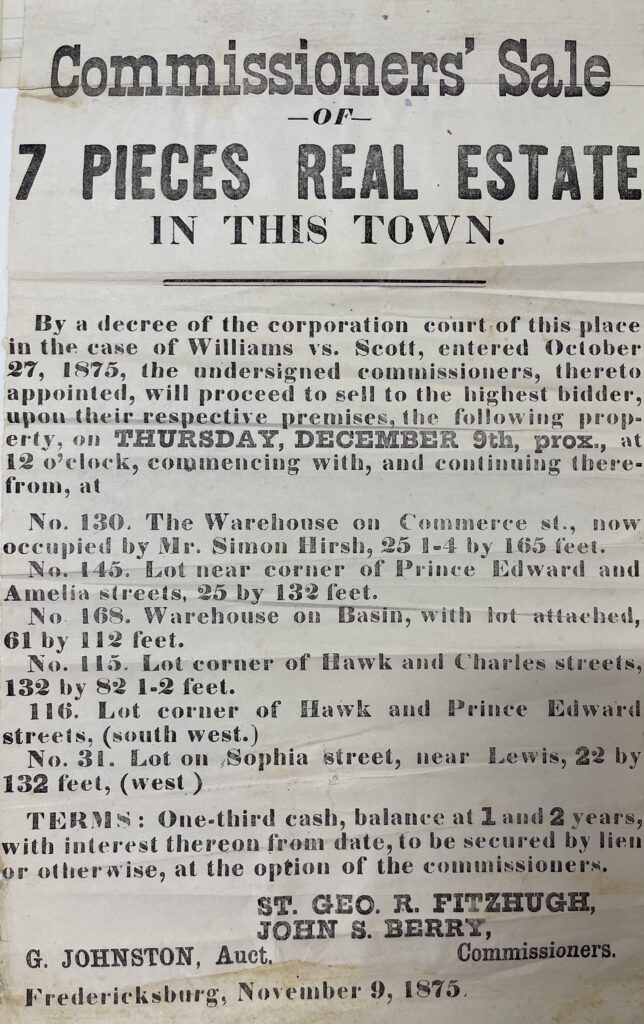
The Jacksons first purchased property in Fredericksburg at a public sale of several lots owned by the Scott family in 1875, leaving farming in King George County behind. Public auctions were a popular way for African Americans to acquire land in post-war Virginia. Urban dwellers, who did not rely on large expanses of land for their livelihood, were also more willing to sell. Finally, families who were free prior to the war often had more capital to invest in property, in contrast to those who were newly emancipated.[5]
Fredericksburg’s racial politics, however, might have concerned the Jacksons who seemed to have hired a straw agent named Simon Hirsh to represent them at the auction.[6] Hirsh, a German Jewish immigrant from Baden Baden, settled in Fredericksburg after the Civil War where he sold clothing and later junk and produce.[7] As one of the only Jewish immigrants in the region, Hirsh must have understood the difficulties of navigating white southern society, which perhaps influenced his decision to help the Jacksons purchase land.[8] In 1878, the commissioners who ran the auction noted that “Hillary H. Jackson” was paying for two parcels gaveled off to Hirsh.[9] Four years later, the same commissioners filed a deed at the courthouse, noting that Jackson had paid in full for Lots 115 and 116.[10]
The Jacksons used the land between Hawk, Charles, and Prince Edward Streets not only to build their own home but also to create a small neighborhood of Black homeowners and renters. In 1891, they sold part of their property to George Scranage followed by Ernest L. Lewis in 1902. The 1900 U.S. Census listed additional Black families on their block, including Grants, Bowes, and Wrights, and several others lived nearby.[11]
Land deeds can tell historians a lot about people’s relationships, and the Jacksons were not alone in using the local courthouse to address familial dynamics. For Lizzie, these documents highlighted her critical role within her family and property ownership. After selling land to Ernest L. Lewis in 1902, Hilliard transferred their remaining real estate to Lizzie, “in consideration of natural love and affection,” a common phrase used by spouses and parents when they gave property to a family member. In this case, it also righted a wrong—Lizzie had not been included in the original deeds when the Jacksons bought Scott’s land at auction. Five years later, Hilliard filed a more elaborate deed, one that was more of an apology than a legal instrument. He admitted that he had “purchased with the money of his wife Susan Elizabeth D. Jackson, and had conveyed to himself by mistake.” Their lots, however, “have always been considered by him and his wife as in reality the property of said Susan Elizabeth D. Jackson.” He wanted the record to show the “true ownership” of their property, although Lizzie agreed that he could continue to “pay the taxes and receive the rents and profits” [underline in the original].[12]
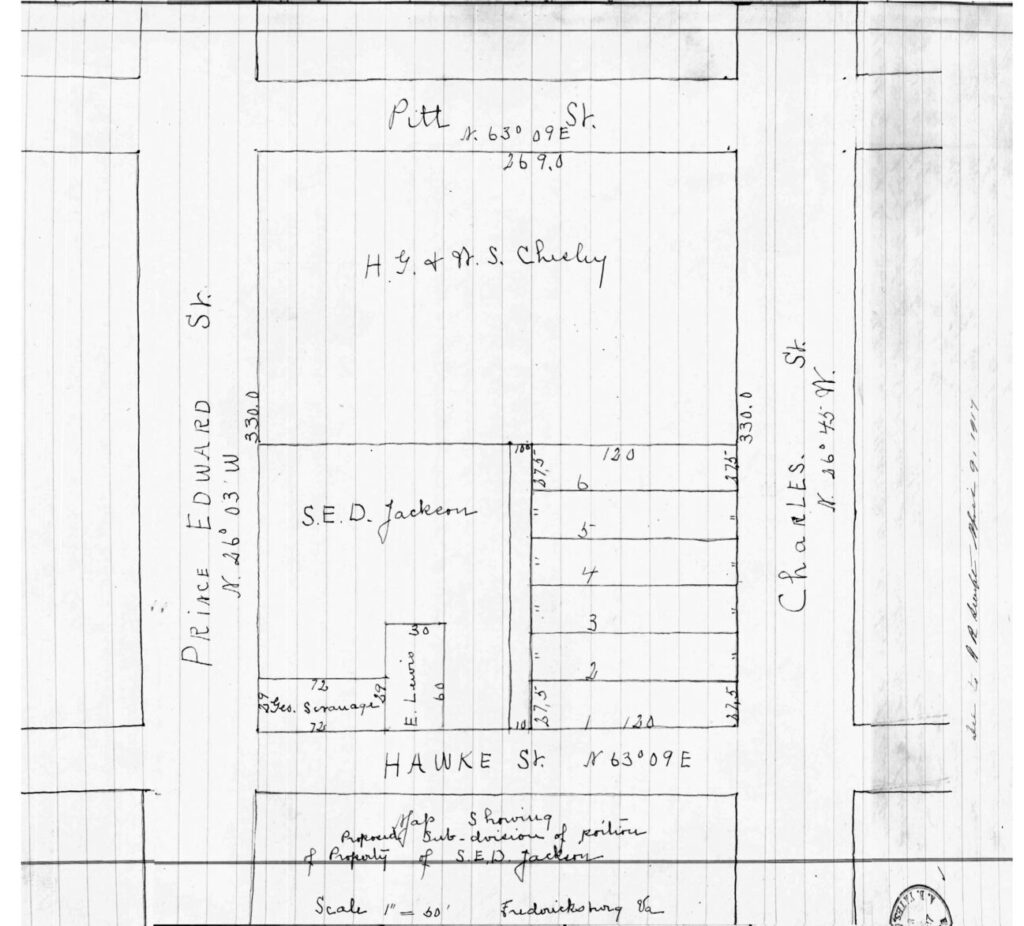
Future land deeds demonstrated that Lizzie indeed managed her family’s properties. In 1909, she bought a neighboring parcel on the steps of the courthouse at auction. Lizzie, the city clerk noted, was “the highest bidder.” The deed was filed four years later after the entire purchase price was paid.[13]After Hilliard’s death and her only surviving child’s migration north, Lizzie used her property to support herself and pay debts. In 1917, she obtained a deed of trust, using her land as a guarantee.[14] She then platted a small subdivision, which the owner of her debt sold at auction in front of a local lawyer’s office.[15]
Lizzie’s friends and neighbors clearly wanted to ensure that the property remained Black owned. Charles Hailstalk (also spelled Hailstork or Hailstark), who was born free in Fredericksburg, lived across the street. He filed the first deeds
Fredericksburg City Courthouse.FiFigure 2:
for the Jackson Subdivision in 1917 for Lot 6.[16] William, possibly a brother or cousin to Charles, and Daisy Hailstalk bought Lots 1 and 2 a year later.[17] Nelson Mercer and Thomas Lee bought Lots 3 and 4 respectively and filed deeds at the courthouse in 1919. Within that same period, they had built houses and appeared on the 1920 U.S. Census as Jackson’s neighbors.[18] Interestingly, Evelyn L. Grant, who also lived across the street with her spouse, Jason, bought Lot 5. She was listed as the sole buyer, providing another example of married women’s role in land ownership.[19]
Three years later, Lizzie was still struggling to support herself and obtained another loan, using her remaining property as collateral. She could not pay it back, but, once again, her friends and neighbors helped. George Scranage, who had bought land from the Jacksons in the 1890s and lived next door, bought her remaining property and the debt against it in 1922.[20] It is unclear where Lizzie lived after Scranage purchased her remaining property. Another neighbor, Helen Coleman, was the official informant for her death on March 21, 1924.[21]
At the time of her death, Lizzie owned no land in Fredericksburg, all of which had been sold off to pay debts. However, her property was transferred to her friends and neighbors, ensuring the persistence of Black property ownership in their neighborhood, at least for the moment.
The block where the Jackson family lived still reflects the way Lizzie subdivided the land over one hundred years ago.
[1] Robert C. Kenzer, Kinship and Neighborhood in a Southern Community: Orange County, North Carolina, 1849-1881(Knoxville: University of Tennessee Press, 1987); Dylan Peningroth, The Claims of Kinfolk: African American Property and Community in the Nineteenth-Century South (Chapel Hill: University of North Carolina Press, 2003); Dylan C. Penningroth, Before the Movement: The Hidden History of Black Civil Rights (New York: Lighright Publishing Corporation, 2023), 56.
[2] Katherine McKittrick, Demonic Grounds: Black Women and the Geographies of Struggle (Minneapolis: University of Minnesota Press, 2006), 3-7; Suzanne Lebsock, The Free Women of Petersburg: Status and Culture in a Southern Town (New York: W.W. Norton and Co., 1985); Marylynn Salmon, Women and the Law of Property in Early America (Chapel Hill: University of North Carolina Press, 1989); Angela Boswell, “Married Women’s Property Rights and the Challenge to the Patriarchal Order: Colorado County: Texas,” p. 89-109, in Southern Womanhood: Dealing with the Powers that Be, edited by Janet L. Coryell, Thomas H. Appleton, Jr., Anastatia Sims, Sandra Gioia Treadway (Columbia: University of Missouri Press, 2000).
[3] Marriage Record, Nelly Runday and Joseph Rivers, April 12, 1802, Caroline County, VA; Marriage Record, Betsy Reaves and Thomas Fortune, March 18, 1824, Caroline County, VA; Virginia Compiled Marriages, 1740-1850; 1820 U.S. Census, Caroline County, Virginia, n. p.; 1850 U.S. Census, Caroline County, Virginia, 309 and 592; 1860 U.S. Census, Port Royal Post Office, Caroline County, Virginia, 186; Lizzie Jackson, No. 7643, Virginia Certificate of Death, March 24, 1924; accessed March 14, 2024, ancestry.com.
[4] 1850 U.S. Census, Caroline County, Virginia, 314, 309, and 592; 1870 U.S. Census, Passapatanzy, King George County, Virginia, 5; Marriage Record, Susan E. D. Fortune and Hillard Jackson, April 7, 1870, King George County, VA; Marriage Record, Frances Jackson and Robert W. Fortune, December 24, 1864, King George County, VA; accessed March 14, 2024, ancestry.com.
[5] Kenzer 104-107.
[6] Williams v. Scott (1888), Fredericksburg City Circuit Courthouse, Fredericksburg, VA.
[7] [Advertisement], Virginia Herald January 17, 1867, 3; [Advertisement], Virginia Herald December 29, 1873, 2; 1880 U.S. Census, Spotsylvania County, Fredericksburg, Virginia, 138; Simon Hirsh, 1843-September 6, 1884, Baltimore Hebrew Cemetery, Baltimore, MD, Find-a-Grave; accessed March 16, 2024, https://www.findagrave.com/memorial/193287804/simon-hirsh.
[8] Lee Shai Weissbach, “East European Immigrants and the Images of Jews in the Small-Town South,” p. 108-142, in Dixie Diaspora: An Anthology of Southern Jewish History, edited by Mark K. Bauman (Tuscaloosa: University of Alabama Press, 2006); Eric L. Goldstein, “‘Now is the Time to Show your True Colors’: Southern Jews, Whiteness, and the Rise of Jim Crow,” p. 134-155, in Jewish Roots in southern Soil: A New History, edited by Marcie Cohen Ferris and Mark. I. Greenberg (Lebanon, NH: University Press of New England, 2006).
[9] Williams v. Scott (1888), Fredericksburg City Circuit Courthouse, Fredericksburg, VA.
[10] Deed Z-572 (1882) and Deed CC-590 (1891), Fredericksburg City Circuit Courthouse, Fredericksburg, VA.
[11] Deed DD-683 (1891) and Deed JJ-141 (1902), Fredericksburg City Circuit Courthouse, Fredericksburg, VA; 1900 U.S. Census, Upper Ward, Fredericksburg, Spotsylvania County, Virginia, 12; accessed March 16, 2024, ancestry.com.
[12] Deed LL-596 (1907), Fredericksburg City Circuit Courthouse, Fredericksburg, VA.
[13] Deed OO-602 (1913), Fredericksburg City Circuit Courthouse, Fredericksburg, VA.
[14] Deed 49-496 (1917), Fredericksburg City Circuit Courthouse, Fredericksburg, VA.
[15] Deed 49-527 (1917), Fredericksburg City Circuit Courthouse, Fredericksburg, VA; [Advertisement], The Daily Star (Fredericksburg, VA), March 5, 1917, 3.
[16] Deed 50-81 (1917), Fredericksburg City Circuit Courthouse, Fredericksburg, VA; 1920 U.S. Census, Fredericksburg City, Spotsylvania County, Virginia, Enumeration District 47, 13B; 1860 U.S. Census, Fredericksburg, Spotsylvania County, Virginia, 86; Charles Hailstalk, Certificate of Death, May 12, 1920; accessed March 24, 2024, ancestry.com.
Charles’s parents, John Hailstalk and Louisa Evans, reportedly married in Fredericksburg on May 6, 1847. John Hailstalk is buried at Shiloh Baptist (Old) Cemetery. Virginia Compiled Marriages, 1740-1850; John Hailstalk (1826-1900), Find-a-Grave; accessed March 24, 2024, ancestry.com.
[17] Deed 50-376 (1918), Fredericksburg City Circuit Courthouse, Fredericksburg, VA; 1920 U.S. Census, Fredericksburg City, Spotsylvania County, Virginia, Enumeration District 48, 2B; William Hailstalk, Virginia Certificate of Death, July 5, 1928; accessed March 24, 2024, ancestry.com.
William Hailstalk’s parents are listed as John Hailstalk and Mary Simons of Westmoreland County, Virginia on his death certificate. It is unclear what relationship he has to Charles, but it is most likely that they were either brothers or cousins.
[18] Deed 51-16 (1919) and Deed 51-11, Fredericksburg City Circuit Courthouse, Fredericksburg, VA; 1920 U.S. Census, Fredericksburg City, Spotsylvania County, Virginia, Enumeration District 48, 2B; accessed March 24, 2024, ancestry.com.
[19] Deed 51-325 (1919), Fredericksburg City Circuit Courthouse, Fredericksburg, VA; 1920 U.S. Census, Fredericksburg City, Spotsylvania County, Virginia, Enumeration District 48, 15B; accessed March 24, 2024, ancestry.com.
[20] Deed 52- 307 (1920) and Deed 55-233 (1920), Fredericksburg City Circuit Courthouse, Fredericksburg, VA.
[21] S.E.D. Jackson, Virginia Certificate of Death, March 24, 1924; 1920 U.S. Census, Fredericksburg, Spotsylvania County, Virginia, Enumeration District 47, 13B; accessed March 14, 2024, ancestry.com.