By Lucas Anderson
The Fairview subdivision is located at the southern end of the 1850 extension of Fredericksburg, bounded by Weedon, Mercer, and Shepherd Streets and Lafayette Boulevard. It is one of the oldest formally subdivided neighborhoods in Fredericksburg, with the plat map dated March 3, 1919.[1] It consists of two full city blocks and parts of four others, containing in total about sixty houses. The subdivision takes its name from the Fairview mansion, which sat on a ten-acre estate that formed the basis for the subdivision. The owner of the house, Wilfred S. Embrey, had bought it in 1883 from engineer John Dunstan,who had the house built around 1875.[2] Upon Wilfred Embrey’s death in 1908, his son, Alvin T. Embrey, subdivided the estate in 1910.[3] However, only one lot was sold before he re-subdivided a smaller portion of the estate in 1919.[4] Alvin Embrey was a prominent citizen of Fredericksburg, serving as the Commonwealth’s Attorney for Fredericksburg from 1896 until 1902, interrupted by a two-year term as a member of the House of Delegates. He was then elected judge of the corporation court, retiring from that position in 1907, and ending his career in private practice law with several power companies as clients, including Fredericksburg Power and Virginia Electric and Power.[5]
Along with the new subdivision of Fairview, Alvin Embrey set up the Real Estate, Loan and Investment Company, which assisted in home building and financing for new homes to be built in Fairview.[6] The Real Estate, Loan and Investment Company aggressively promoted home ownership to renters, touting the benefits of community cohesion and long-term low-effort financial gain in real estate.[7]
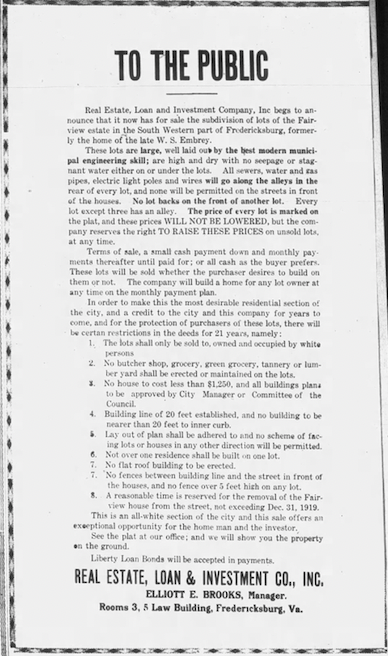
The deeds conveying the land came with a standard set of covenants, which restricted future use of the land until the specified end date of January 1, 1940; given that the plots were sold starting in March, 1919, the covenants had a duration of twenty-one years or less, which is in line with traditional concepts of property law.[8] The most prominent covenant, the first in the list, prevented the possession of or occupation by “any other than white persons” for the duration of the restrictions, in explicit legal terms.[9] The other seven covenants place various aesthetic restrictions on the property, which restrict density, setback, roofing, fencing, and house cost, in addition to what sort of business may be carried out on the lots.[10] The deeds also prohibited the sale of alcoholic liquors, which was already prohibited by the Eighteenth Amendment the year beforehand.[11]
Figure 1. Advertisement for Fairview from the Real Estate, Loan & Investment Co., Inc.
Table 1: Ownership of Lots in Central Block in Fairview in 1930, with Occupations
| Name | Occupation | Lot # |
| Ray C. Jones | Clerk, Furniture Store | 1 |
| Charles E. Powell | Drayman, Hauling | 2 |
| Clarence S. Shelton | Clerk, Lumber Company | 3 |
| Effie V. Saunders | None | 4 |
| Oliver C. Shelton | Manager, Fertilizer and Good Store | 5 |
| Willie I. Pollard | Engineer, Rail Road | 6 |
| Roland D. Toombs | Car inspector, Rail Road | 7 |
| Earnley F. Bellomy | Carpenter, Cabinet Maker | 43 |
| Mary E. Wenger | Clerk, City Post Office | 41 |
| Preston W. Leacock | Baggage Clerk, RF+P Rail Road Depot | 40 |
| William S. Johnson | Black Smith, Black Smith Shop | 39 |
| Sidney D. Klor | Druggist, Drug Store | 38 |
| Julian C. Clarke | Manager, Service Station | 37 |
| James H. Marsh | Laborer, City Glass Works | 36 |
| Ella R. Hughlett | None | 35 |
| Joe W. McWert | None | 34 |
[1] Deed Book 51, Pages 84–85 (1919), Fredericksburg City Courthouse, Fredericksburg, Virginia.
[2] Deed Book AA, Page 308 (1883), Fredericksburg City Courthouse, Fredericksburg, Virginia; 1880 U.S. Census, Fredericksburg, Spotsylvania County, Virginia, Enumeration Dist. No. 138, 10B, accessed April 13, 2024l ancestry.com; Table of Town Lots (1876), Fredericksburg City Courthouse, Fredericksburg, Virginia.
[3] Register of Deaths, Stafford County, Virginia, 1894, 1, Stafford, 1876–1896, Virginia, U.S., Death Registers, 1853–1911, accessed April 8, 2024, Ancestry.com. Deed Book NN, Page 241 (1910), Fredericksburg City Courthouse, Fredericksburg, Virginia.
[4] Deed Book 50, Page 25 (1917), Fredericksburg City Courthouse, Fredericksburg, Virginia.
[5] “Judge A. T. Embrey Dies; Retired Attorney Was 83,” The Free Lance-Star, February 18, 1957.
[6] “To the Public,” The Daily Star, February 20, 1919.
[7] “Making Money,” The Daily Star, March 11, 1919.
[8] See supra note 7 for information about the deed covenants. Deed Book 54, Page 287 (1922), Fredericksburg City Courthouse, Fredericksburg, Virginia. Richard R. W. Brooks and Carol M. Rose, Saving the Neighborhood: Racially Restrictive Covenants, Law, and Social Norms (Cambridge: Harvard University Press, 2013), 75.
[9] The full text of the restriction is: “Neither the lot herein conveyed, nor any part thereof, nor any building or structure that may be erected thereon, shall be sold, conveyed, leased, rented or otherwise disposed of, to any other than white persons as the owners or tenants thereof.” Deed Book 54, Page 287 (1922), Fredericksburg City Courthouse, Fredericksburg, Virginia.
[10] Ibid.
[11] Ibid.