By Aidan Smagh
In 1927, the Hanover Heights Development Company, led by Maurice Broaddus Rowe, William K. Goolrick, and John W. Allison, created the aptly named Hanover Heights subdivision in Fredericksburg, Virginia. These three men came from different backgrounds, but all of them had a vested interest in the company’s success. Based on the 1930 U.S. Census, Rowe was a white farmer in Spotsylvania County, Virginia. The Rowe family owned Brompton, a nearby estate made famous as the temporary headquarters of the Confederacy during the two Battles of Fredericksburg.[1] The home came into the Rowe family’s possession after the Civil War and was eventually passed down to Maurice Broaddus Rowe. Goolrick was a local business owner and lawyer in Fredericksburg. John W. Allison worked in real estate, most likely developing suburban home lots in and around town. Like Rowe, Allison lived in Spotsylvania County, although he was born in Fredericksburg.[2]
Rowe, Goolrick, and Allison outlined why they started this company in their charter. The Hanover Heights Development Company sought “to acquire by purchase, lease, own, hold, sell, mortgage, or encumber both improved and unimproved Real Estate.” Specifically, they wanted to establish a modern residential subdivision on what was previously open land owned by the Rowe family. Aside from selling suburban lots to would-be homeowners, the company provided infrastructure for the neighborhood by building sewer and water lines and sidewalks.[3]
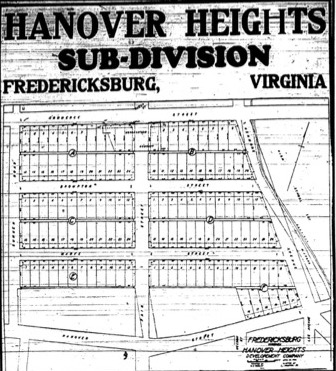
The subdivision consisted of four blocks between Marye and William Streets, Kenmore Avenue, and Sunken Road. The Company deeded each parcel with specific restrictions, including setbacks, fences, and an assessed value of “no less than $2500.00,” a common practice that was believed to increase property values.[5] The other covenants on these lots restricted the lands’ use to be solely for residential purposes as well as limiting the types of buildings erected on the property. It can be speculated that prospective purchasers bought parcels with the goal that they would build homes some time in the future. Based on a review of initial purchases in Block D, white individuals and families bought lots from a variety of socio-economic backgrounds (see Table 1).
Table 1: Initial Hanover Height Property Owners of Block D, 1930 Census
| Name | Race | Occupation | Lot # |
| William E. Biscoe | W | Bookkeeper at Commercial State Bank | Lot 1 |
| Lafayette H. Biscoe | W | Bookkeeper at Commercial State Bank | Lot 2 |
| John E. Gallahan | W | Electrician | Lot 3 |
| L. W. Jett [Lora or Lulu] | None | Lot 4 | |
| Wilbur D. Jones | W | W. D. Jones & Bros. Grocer | Lots 5-6 |
| Harry Wheeler | W | Fireman at City Gas Works | Lot 7 |
| Howard R. Masters & Ada M. Gibson | W | Lumber and Building Supplies | Lot 8 & 25 |
| Lucas Construction Company, Inc. | W | not applicable | Lot 9 |
| Bettie E. Heflin | W | no occupation | Lot 10 |
| Margaret Flippo | W | Homemaker | Lot 11 |
| Robert E. Coppage | W | Truck driver | Lot 12 |
| Q. J. Herring | W | Salesman | Lots 13-14 |
| B. A. Snellings [Beryl or Burrows] | W | Clerk Sanitary Gro Co | Lot 15-23 |
| T. Benton Gayle | W | Superintendent of Education | Lot 24 & 26 |
106 of the 115 lots in the subdivision had racially restrictive covenants. All of these deeds used the same restrictive language: “Neither the land nor any part thereof, nor any building of structure that may be erected thereon, shall be sold, leased, rented or otherwise disposed of to any other than white persons as the owners or tenants for a period of fifty years from the date of this deed.”[6] These covenants largely restricted the ability for African Americans to move into this neighborhood. During this period, there was a common fear that allowing African Americans into such neighborhoods would lower the overall property values. This covenant, however, was dissimilar from the ones used in the Kenmore and College Terrace subdivisions, which specifically excluded African Americans. Instead, Hanover Height’s developers relied on newly emerging eugenical thought that created a white/non-white divide.[7]
The nine lots in Hanover Heights without racially restrictive covenants were situated along William Street, a major thoroughfare in Fredericksburg. Frank Chichester, a local white lawyer, owned every lot without a racially restrictive covenant and was involved in real estate transactions in the area.[8] It is unknown what Chichester’s specific plans were for these parcels but he may have planned to create a commercial district along William Street, which exists today. Without racially restrictive covenants, Black men and women would be allowed to shop, work, and even live in the potential commercial district. Black owned property was also nearby in Liberty Town, an African-American neighborhood about one block east of Hanover Heights. Liberty Town emerged in 1812 through the efforts of Seth Barton, a white merchant. Eventually, Fredericksburg annexed Liberty Town in 1851, which also served as a cemetery until after the Civil War. The removal of the cemetery allowed Black homes and businesses to populate the area. Newly freed Henry Dean arrived at Liberty Town in 1868 and helped to develop the neighborhood, specifically constructing new houses for Black families.[9]
Hanover Heights still exists today, and largely reflects the design of its original developers in the early twentieth century.
[1] Fredericksburg Historic and Business Guide (Fredericksburg, VA: James A. Brown Princess Anne Hotel, 1933), 20.
[2] 1930 U.S. Census, Courtland District, Spotsylvania County, Virginia, Enumeration District 89-5, 10A, accessed March 29, 2024, ancestry.com.
[3] Ruth Coder Fitzgerald, “Hanover Heights Early Subdivision in Fredericksburg’s Development,” The Free Lance-Star December 16, 1929.
[4] Ruth Coder Fitzgerald, “Hanover Heights Early Subdivision in Fredericksburg’s Development,” The Free Lance-Star December 16, 2000.
[5] Larry Santucci, “How Prevalent Were Racially Restrictive Covenants in 20th Century Philadelphia? A New Spatial Data Set Provides Answers,” Federal Reserve Bank of Philadelphia, (November 2019): 6; https://doi.org/10.21799/frbp.dp.2019.05.
[6] Deed Book 65, Page 5 (1930), Fredericksburg City Courthouse, Fredericksburg, Virginia.
[7] Lisa Lindquist Dorr, “Arm in Arm: Gender, Eugenics, and Virginia’s Racial Integrity Acts of the 1920s,” Journal of Women’s History 11, no. 1 (Spring 1999): 143-166.
[8] Deed Book 68, Page 98 (1934), Fredericksburg City Courthouse, Fredericksburg, Virginia; “Executors Sale of Valuable Real Estate,” The Free Lance-Star February 14, 1911.
[9] W. Kevin, “Liberty Town Fredericksburg: Timeless,” The Historical Marker Database, March 4, 2023, accessed April 15, 2024, https://www.hmdb.org/m.asp?m=33107.