By Natalie Lee
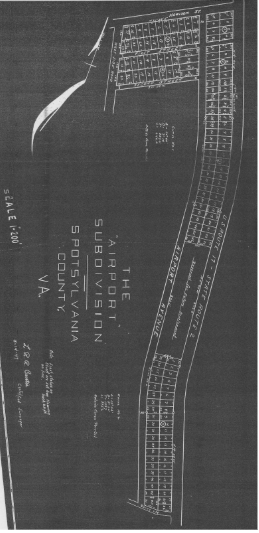
The Airport Subdivision resides south of the Mayfield neighborhood along Route 17 and east of the modern day fairgrounds in Fredericksburg. It was originally platted as a six block subdivision in 1947, and then two additional residential blocks were added in the late 1950s. In the 1940s, this land was a part of the Garner Aviation Airport or Shannon Field before being purchased by the Graves Development Company. Nelson A. Graves, owner of Graves Development Company, began selling lots in the Airport Subdivision in 1947. Fredericksburg annexed Airport from Spotsylvania County in 1954 as part of the city’s expansion of its overall footprint in response to post-World War II population growth.
The Airport Subdivision was created by four developers who oversaw the construction and sale of homes. Elliott B. Meredith was born in Elko, Nevada and moved to Fredericksburg in 1929. 1 Meredith was a co-developer of Airport, and an instructor at Garner Aviation Service. He was also a local car sales manager. Nelson A. Graves Sr., a prominent developer, was the president of Colonial Small Loan Company, Colonial Discount Corporation, and a broker with Association Finances Services.2 His main job was administrating small loans. Bascom S. Pribble Jr., a lawyer, was the brother of Emily Graves, Nelson A. Graves’s spouse. 3 He was a prominent figure in the local justice system, and a real estate developer in the Mayfield area. He also helped to develop Grafton Village, Sheraton Hills, and Ingleside Farm in the Fredericksburg area. Finally, William L. Nuckols was the youngest of the group by nearly 20 years. When his mother passed, he lived with his aunt and uncle, Bessie Nuckols and John C. Whitlock, who were farmers in Mineral, Virginia. 4 After World War II, he was working at Colonial Small Loans in Fredericksburg as a manager. 5
Figure 1 to the right: Airport Subdivision Plat Map*
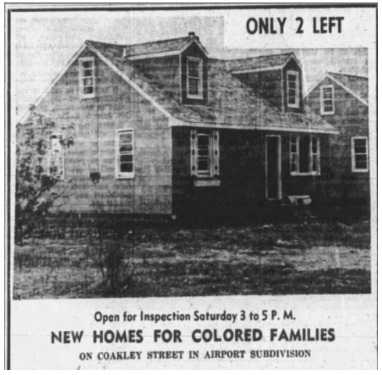
For the northern blocks of Airport, developers specifically advertised to Black residents to rent and buy pre-built homes. These blocks were adjacent to Mayfield, a Black neighborhood established in the early twentieth century. For white developers, African American homebuyers were potentially a way to make additional profits. The circumscribed nature of the segregated housing market meant African Americans were often charged more for the same property. Additionally, post-World War II Black residents in Fredericksburg and elsewhere had experienced some economic prosperity and could afford to purchase newly constructed homes. These houses came with covenants in the land deeds that included: “no pigs or hogs shall be on the premises” and houses should be “$3000 or more.”6 These restrictions reflected the role that class played in the insertion of covenants for both Black and white homebuyers. Airport’s developers pre-built houses and advertised them as “new homes for colored families” that had “water and sewage… where each [house] is equipped with oil heat, cabinet sinks, and hot water heaters.”7 These modern amenities were also signs of the expansion of the Black middle class.8
Meanwhile, southern portions of the Airport Subdivision, separated by a small undeveloped area and located across the Sylvania Cellophane Plant, contained properties with white-only racially restrictive covenants. This plant, which ran from 1929 to 1978, was a major source of jobs for many Fredericksburg locals. It is not surprising that racial covenants were located on parcels near this prominent factory, which had a segregated workforce. Land deeds in this portion of Airport included a covenant that stated the following: “no property or any part of it, shall not be sold to, nor occupied as owners or tenants by any person not of the Caucasian race.”9 A nuisance clause, which stated that “no nuisance shall be maintained nor permitted on the said property” was also included.10 This language was another way to police the racial and class makeup of the neighborhood. Additional restrictions included: “residential purposes only” and “no residence shall be built on any lot costing less than $3500 per lot,” all of which speak to the racial and class priorities of developers.11 It’s important to note that, in the case of Shelley v. Kramer (1948), the U.S. Supreme Court decided that racially restricted.
Figure 2 to the right: New Homes for Colored Families Newspaper Advertisement, Courtesy of newspapers.com
The last of the established eight plots were sold in 1956. Lots continued to be sold in the 1970s by Nelson A. Graves’ son. Today, many of the racially restricted areas are commercial stores, not residential neighborhoods. Residential houses still stand on the northern blocks of Airport and are generally perceived to be part of the Mayfield neighborhood.
- “Prop-Wash,” The Free Lance-Star, May 1, 1946. Accessed December 11, 2025. https://www.newspapers.com/
↩︎ - “Nelson Graves, finance executive, dies at 69,” The Free Lance-Star, December 15, 1976. Accessed December 2, 2025.https://www.newspapers.com/
↩︎ - “Bascom Pribble Jr. dies, well-known area attorney,” The Free Lance-Star, May 9. 1979. Accessed December 5, 2025. https://www.newspapers.com/
↩︎ - “1930s Federal Census, Enumeration District 53-11,” Accessed December 2, 2025. https://www.ancestrylibrary.com/ ↩︎
- “”William L. Nuckols,” The Free Lance-Star, Accessed December 11, 2025. https://www.newspapers.com/ ↩︎
- Deed book 162, Page 478 (1950), Spotsylvania Court House, Spotsylvania, Virginia.
↩︎ - “New Homes for Colored Families,” The Free Lance-Star, May 7, 1954. Accessed December 2, 2025. https://www.newspapers.com/
↩︎ - Deed book 154, Page 286 (1951), Spotsylvania Court House, Spotsylvania, Virginia. ↩︎
- “Deed book 151, Page 175 (1950), Spotsylvania Court House, Spotsylvania, Virginia.
↩︎ - “Deed book 151, Page 175 (1950), Spotsylvania Court House, Spotsylvania, Virginia.
↩︎ - “Deed book 151, Page 175 (1950), Spotsylvania Court House, Spotsylvania, Virginia.
↩︎