By Natalie Lee
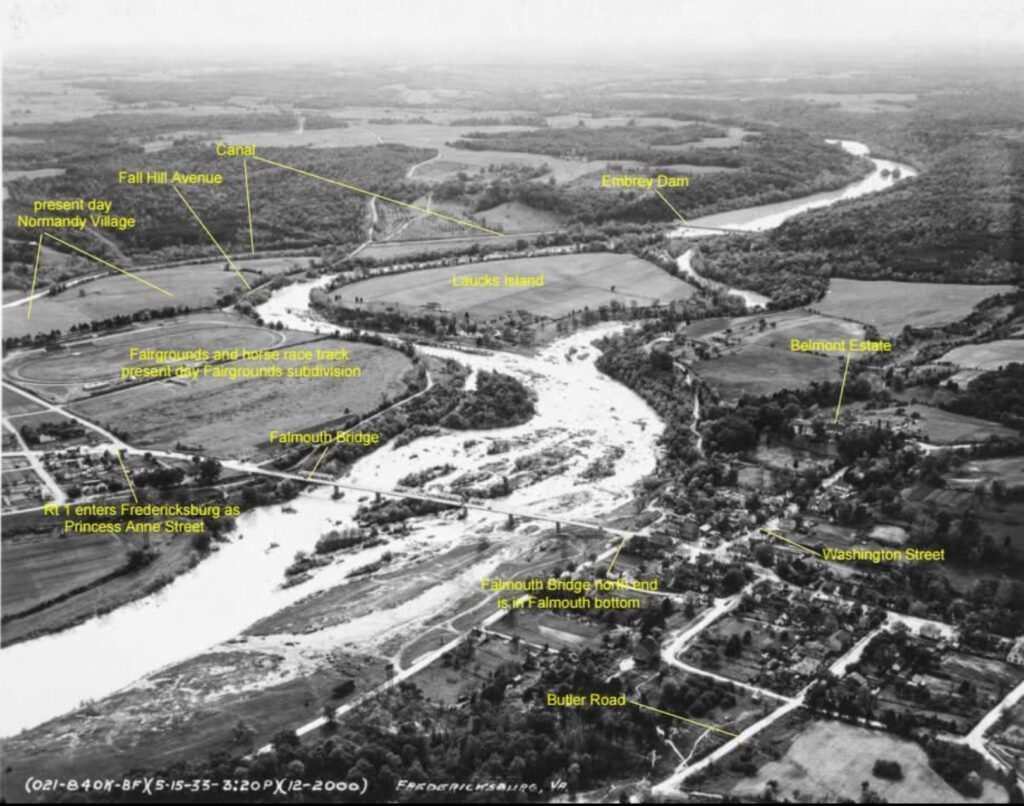
The Fairgrounds subdivision resides on the northside of Route 1, just before the Falmouth Bridge on the Fredericksburg side of the Rappahannock River. It was originally platted as a 15-block subdivision in 1940, but now stands at 13 blocks as a result of Route 1’s expansion. The Fredericksburg Fair Association owned the original 60 acres, which it had used to showcase livestock and agricultural exhibits as well as annual community fairs starting in 1887.[1] In 1938, the Fredericksburg Fair Association declared bankruptcy due to “lack of patronage,” most likely caused by the Great Depression combined with a decline in agricultural production in the region.[2]
Figure 1: Labeled Aerial Photo with Fairgrounds, 1933. Courtesy of Stafford County GIS.
To pay its debts, the Fredericksburg Fair Association had hoped to sell off their property, but when the organization went into bankruptcy, the court appointed commissioners who platted and auctioned off individual lots to address the Association’s financial troubles.[3] It is important to note that no covenants were inserted into the deeds for property sold by the commissioners, who were acting as representatives of the government. Local governments usually did not insert covenants, especially racially exclusionary ones, into land deeds, which potentially would be seen as a violation of the U.S. Supreme Court’s decision, Warley v. Buchanan (1917).[4] Thus, residents had to add covenants to Fairgrounds using a legal instrument known as a neighborhood agreement.
At Fairgrounds, both prospective homeowners and real estate developers bought parcels. Developers bought whole blocks of land in order to build housing, which was easier than buying individual lots across the subdivision. Before the court appointed commissioners auctioned off the land, the City of Fredericksburg also bought block 1 to build expand an armory while parts of blocks 1, 2, and 3 and the entirety of block 4 became part of Route 1.[5]
Fairground’s racially restrictive covenant differed from other subdivisions in Fredericksburg because it appeared in a neighborhood agreement. A neighborhood agreement is a legal instrument signed by individuals who own land in close proximity to each other and agree to act in a specific way in their community. If someone broke a neighborhood agreement, then other signatories could take them to court. In the case of Fairgrounds, 70 residents agreed that lots would not be “sold, leased, used, or occupied by any person of African descent.” However, within the same neighborhood agreement, it noted that the racial restriction would not apply to “residence(s) of colored domestic servants” who work for the residents.[6] The neighborhood agreement, which was written in 1941, also noted that this covenant would be in place for 99 years. This long period of time broke the Rule Against Perpetuity (RAP), which is a legal principle that recognizes that land use changes over time and limits how long a covenant can be enforced.[7]
Table 1: Buyers of parcels of Fairgrounds Subdivision, 1940.*
| Grantees | Block | Lots |
| Thomas B. & Virginia Payne | 3 | 11-12 |
| C.C. Cloe | 15 | 9-10 |
| Robert B. & Elizabeth D. Payne | 7/7/15 | 1/5/13 |
| W.W. Butzner Jr. | 2 | 12-13 |
| W.T. & Virginia D. Powers | 2/15/15 | 11/1/15 |
| C.A. & Constance E. Abbey | 2/6 | 8/all |
| C.F. & Mary Bailey Unruh | 2 | 14 |
| Solly and Lillie V. Ventura | 13/13 | 14-16/24 |
| Robert W. & Susie S. Harris | 13/14 | 17-20/ 10-11 |
| W. Percy & Gertrude Brown | 13 | 21 |
| H.H. & May Y. Tyler | 14/15 | 6/ 3-4 |
| Roger & Lula C. Clarke | 10 | all |
| Stuart & Florence P. Tansill | 15 | 14 |
| S.P. & Dorothy V. M. Powell | 15 | 16 |
| John W. & Mary Elizabeth Allison | 8/2 | 15-16/ 1, 2, 4, 5, 7, 9, 10, 15, 16 |
| Alex P. & Frances G. Gayle | 7/7/14/14/15 | 2/8/13/15/7-8 |
| John Harden & Rosalie J. Hill | 13/15 | 10/11 |
| Mary L. & Walter Purks | 7/7/7/12 | 3/6/9-10/all |
| Harvery & Edith Mills | 7 | 11 |
| J.T. Lefoe Jr. | 7 | 12 |
| Harvery Lee & Helen B. Jones | 7 | 13 |
| Clinton Southworth | 13 | 1 |
| Cecil & Caroline G. Reid | 7/14/14/14 | 14/12/14/16 |
| N.A. & Pauline S. Ashby | 8/11/14 | all/all/ 1-5 |
| A.W. & Keene D. Embrey Jr. | 9/15/15/15 | all/2/5-6/12 |
| J.W. & Elizabeth Rose | 13 | 2-3 |
| Joseph & Ella A. Ollie | 13/13 | 4/22-23 |
| George I. & Pearl Sacrey | 13 | 5 |
| Ruth Oldo | 13 | 7 |
| Hugh S. Hamilton ℅ W. J. Gibson | 14 | 7-8 |
| Ray Hall | 14 | 9 |
| George Isacrey | 13/13/13 | 13/8/5 |
| J. Wilmore Cox | 13 | 9 |
| City of Fredericksburg | 1/3 | all/all |
*Deed book 76, Page 1-4 (1940), Fredericksburg City Courthouse, Fredericksburg, Virginia.
Had the U.S Supreme Court not ruled in Shelley v. Kraemer (1948) that racial covenants were unenforceable, and the U.S. Congress made them illegal with the passage of the Fair Housing Act (1968), Fairgrounds would still be a racially restricted subdivision. Its racial restriction was to be enforced until 2040. Today, Fairgrounds is primarily single-family housing, much of which remains eclectic as it was when it was first established, as well as few commercial stores along Route 1.
[1] “Suit Filed To Liquidate Fredericksburg Fair,” Orange County Review, January 20, 1938. Accessed April 4, 2025. https://www.newspapers.com/
[2] “Suit Seeks Sale of Fair Grounds Tract,” The Free Lance Star, Fredericksburg, Virginia, January 17, 1938. Accessed April 4, 2025. https://www.newspapers.com/
[3] “Buchanan v. Warley.” Oyez, Accessed 29 Apr. 2025. https://www.oyez.org/cases/1900-1940/245us60
[4] “Valuable Lots At Public Auction: Fredericksburg Fair Grounds Property,” The Free Lance Star, April 27, 1940. Accessed April 4, 2025. https://www.newspapers.com/
[5] Deed book 127, Page 87 (1941), Fredericksburg City Courthouse, Fredericksburg, Virginia.
[6] Deed book 127, Page 87 (1941), Fredericksburg City Courthouse, Fredericksburg, Virginia.
[7] Larry Santucci, “Documenting Racially Restrictive Covenants in 20th Century Philadelphia,” U.S. Department of Housing and Urban Development, no. 3 (2020), accessed January 20, 2025. JSTOR.