Murder. An unscrupulous lawyer. Political infighting. These words are not what you expect to find when researching the history of Black property ownership. For Kate Russell Lee, a Black woman who owned over forty acres of land outside of Fredericksburg, Virginia, that’s exactly what happened in 1913. Her story, like so many others, shows not only the adversity that Black women faced in the early twentieth century but also the ways in which they fought back and, in this case, won.
Like many newly emancipated families, Lee’s parents pursued property ownership in the late nineteenth century, which was seen as a pathway to economic stability and full citizenship. Born in Stafford County, Virginia, John and Eliza (Henry) Russell first appeared in the archival record in the 1880 U.S. Census living in Spotsylvania County, not too far from Fredericksburg. John worked as farmer, while Eliza was listed as “keeping house,” a phrase that obscured the many forms of paid and unpaid labor that Black women performed. Their only child, Catherine (also known as Kate), attended school. She would be the only family member to know how to read and write.[1]
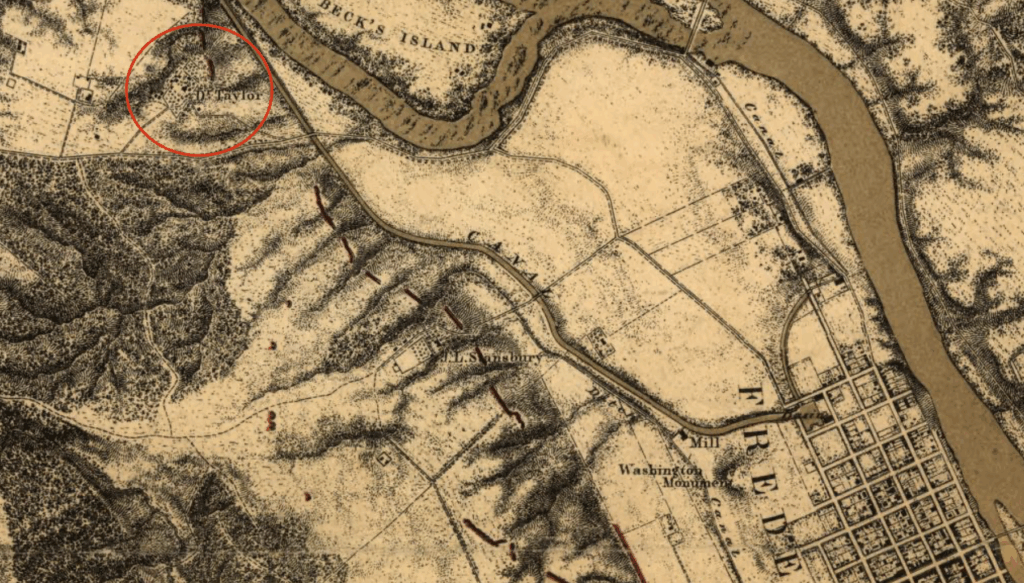
The Russell family had settled on land that they had purchased in Spotsylvania County, only a few miles from where John Russell had been enslaved to John L. Taylor. Taylor, a physician, enslaved forty-six people, based on the 1860 Slave Schedule, who most likely lived and worked on his plantation, Fall Hill.[2] In 1872, Walker and Eliza V. Landram, white farmers who lived and worked in the county, sold John Russell 5.54 acres for $110. It’s unknown why Landram chose to sell this property, but we can speculate that, at seventy-six years old, he struggled to run his farm without an enslaved labor force. The Landrams had enslaved at least thirteen people prior to the Civil War.[3]
By 1900, the Russells’ land holdings had expanded to 41.29 acres. They had bought an additional fifteen acres from Louis and Emma Stevens in 1888, another white farming family in Spotsylvania County. In comparison to the Landrams and Taylors, the Stevens, who had recently inherited their farm from Louis’s parents, were a much less affluent family.[4] The Russell’s last parcel came from William F. Gordon, most likely the well-known, former Confederate officer and civil engineer who lived in Fredericksburg.[5]
Lee inherited her parents’ land when they both died within days of each other in 1909. Although married with children, she had been living with her parents since at least 1900. Her husband, Tolman E. Lee, worked in major cities in the Mid-Atlantic and New England regions, most likely because of rural Virginia’s limited job opportunities. While Lee and her children ran the family farm, they also supplemented their income working for white families in the neighborhood.[6]
The precarity of Black womanhood in the Jim Crow South soon reached Lee’s front door when her sons-in-law became suspects in a murder. The case began with the gruesome killing of Lee’s neighbors, Mansfield and Melvina Thornton, on December 13, 1912. George Scott and John Miller, Lee’s sons-in-laws, ran to the Thorntons’ home to put out a fire, which the murderer had started to hide the crime. After the fire was extinguished, the Thorntons’ remains were discovered.[7]
The next day, the sheriff detained both Miller and Scott after F. L. Hargrove (the actual murderer) implicated them in the crime. Within hours, Lee J. Graves, a Fredericksburg-based lawyer and real estate broker, arrived at Lee’s house to tell her that Miller needed legal representation and offered his services. Scott’s father, Edward, had already hired Graves to represent his son. Lee told Graves that she had no money, but he said that was not a problem. He asked her to go to his office in Fredericksburg to sign papers the next day. Unknown to Lee at the time, those papers placed a mortgage lien on her family’s land. If she did not pay the lien by a set date, she would lose her property.[8]
Questionable legal practices by white lawyers were not uncommon in early twentieth-century Virginia. Dylan Penningroth in Before the Movement documents the ways in which white lawyers worked for Black clients, with a variety of outcomes. At the same time, he notes that Black men and women educated themselves on the law to ensure that certain basic rights, despite living during the height of Jim Crow segregation, continued to be protected.[9] Lee hired a lawyer and sued Graves.
During the summer of 1913, Fredericksburg was abuzz with a new drama that not only played out in the court but also the local newspapers. A judge had released Miller and Scott months earlier, while F. L. Hargrove had been found guilty and sent to the electric chair.[10] In July, C. O’Conor Goolrick, Lee’s new attorney, filed a suit against Graves to have the mortgage lien rescinded. Goolrick, one of the most esteemed lawyers in Virginia, represented Fredericksburg in the General Assembly and would later serve as a state senator, mayor, and city attorney. In the courtroom, Goolrick portrayed Lee as an “old, ignorant colored woman” (playing to racist and sexist stereotypes) who had been “fooled and defrauded” by Graves. Graves countered, noting that Lee was only forty-five years old, which did not make her “old.” In his mind, she was also “far above the average in intelligence and writes a good hand.”[11] At the same time that the court listened to arguments in Lee v. Graves & Graves, trustees (1913), Goolrick and Graves aired their grievances against each other in the Free Lance-Star. For Graves, Lee’s case was not about his questionable conduct towards Lee, but Goolrick’s frustration that Graves had not supported his candidacy for the state legislature. Goolrick, however, quickly responded to Graves’s allegation, arguing that Graves’s support of his candidacy would have been “a political liability rather than an asset.” Instead, Goolrick noted that what Graves had done to Lee was a violation of their profession’s code of ethics and reflected a pattern of behavior that Goolrick abhorred.[12] Goolrick won the case, not only in the court of law, but also in the court of public opinion.
Graves’s legal maneuvers almost destroyed the land wealth that Lee’s parents had built for their daughter over the course of the late nineteenth century, and Lee still struggled to manage her family’s land for the rest of her life after the lawsuit. By 1916, she signed a contract with James B. Colbert, another local white farmer, to log part of land and install a temporary sawmill to make planks and slabs. In 1920, Lee was still working for white families as a laundress, while one of her adult daughters and her family lived with her. Lee’s death certificate from 1940 notes that she had died from gangrene caused by frostbite combined with physical exhaustion. She was still working as a domestic, probably as a laundress, while taking care of her family’s land.[13]
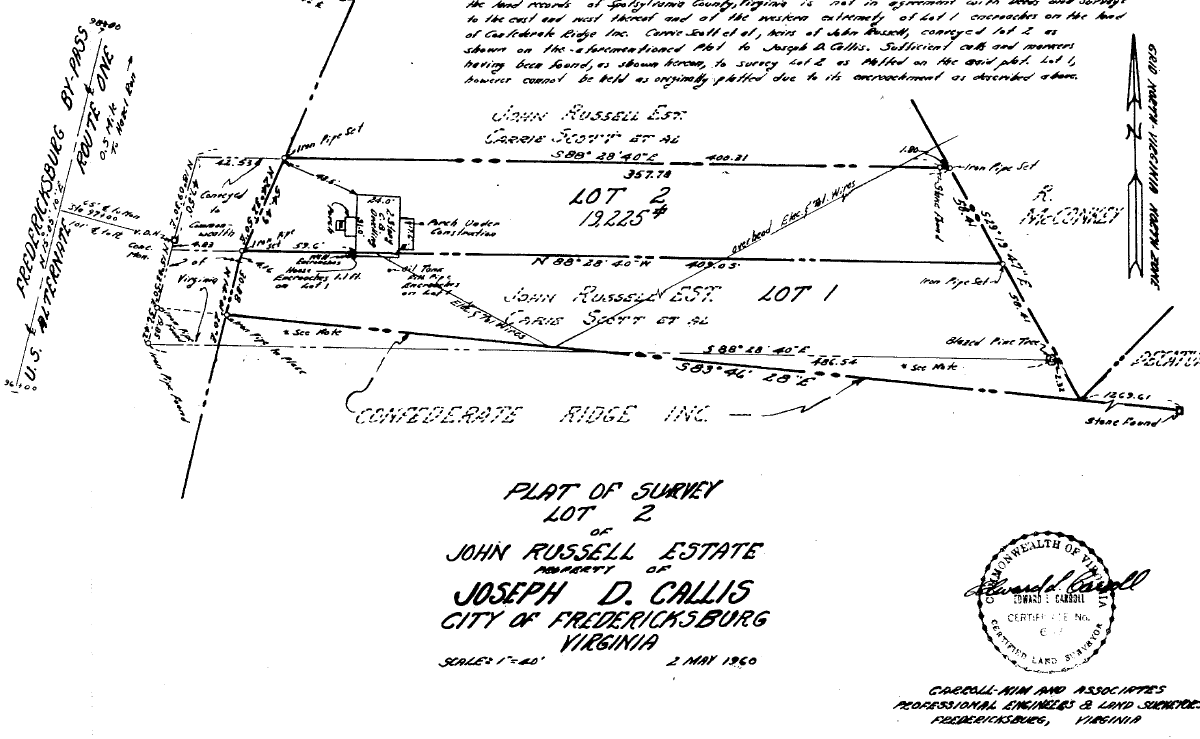
Lee’s four children inherited the land from their mother upon her death and managed the property together. Like other Black families who lived in what was at one time rural Virginia, they faced new forms of adversity tied to Fredericksburg’s suburban sprawl, which included the construction of white-only subdivisions followed by the annexation of the area where the land was located by city government. Land use had changed in the region, starting with the construction of Alternate Route 1, which bisected Lee’s property. While none of Lee’s children lived on the family land, they agreed to sell off small parcels along Alternate Route 1 to Black families, most likely for home construction. At least three families—Floyd and Alice Chambers, Joseph and Lillie Mae Callis, and Beverly and Alice Jones—bought small parcels of less than one acre.[14]
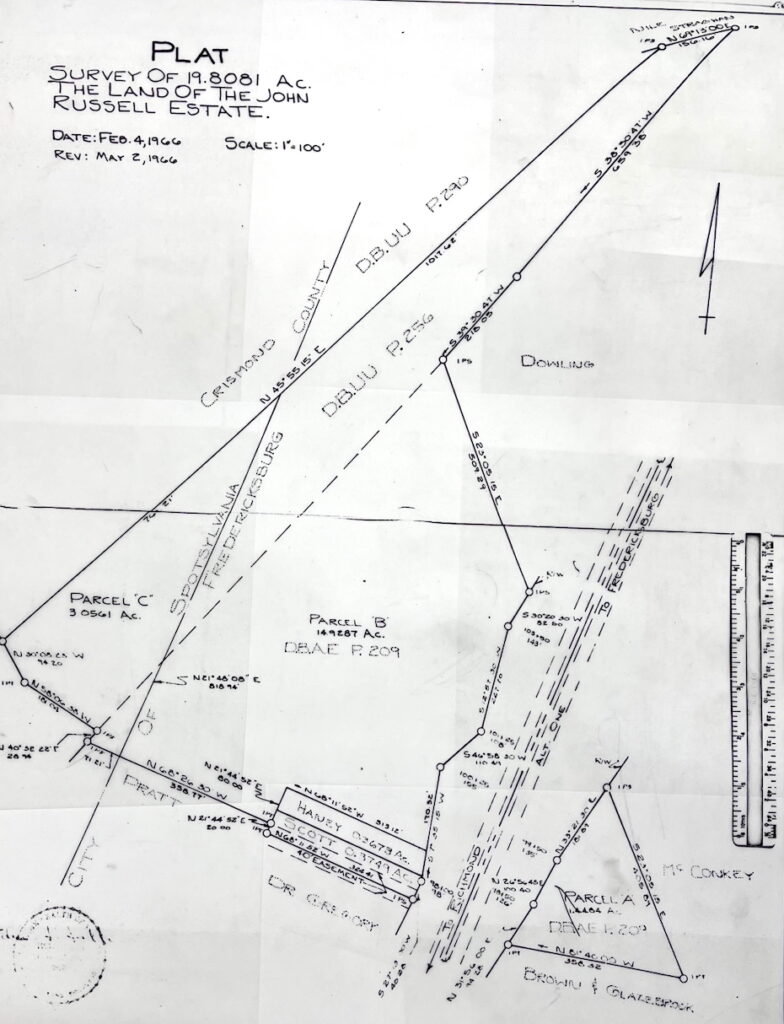
Today, the property that Lee’s heirs sold to Black families, along with Lee’s property itself, has been converted into commercial use. The one exception is Zion Baptist Church (2222 Emancipation Hwy), which sits on a triangle-shaped parcel that is located on the east side of Alternate Route 1 .
[1] “John L. Russell,” The Free Lance-Star (Fredericksburg) March 6, 1909; 1860 Slave Schedule, St. Georges Parish, Spotsylvania County, Virginia, page 79, John R. Taylor, row 1, line 2, digital image; 1860 U.S. Census (Population Schedule), St. George Parish, Spotsylvania County, Virginia, page 118, John R. Taylor household, lines 34-40, digital image; accessed November 26, 2025, http://www.ancestry.com.
A handful of other African Americans were reported to be enslaved to Taylor: William and Frank Burrell; Robert E. Lee; and Abraham and Hester Tuckson. See “A Good Man Gone,” The Free Lance-Star (Fredericksburg, VA) February 19, 1886; “A Respected Colored Man Dead,” The Daily Star (Fredericksburg, VA) June 6, 1917; Pension Case Hester Tuckson, Deposition A, No. 163009, December 5, 1902; Mysteries & Conundrums: Exploring the Civil War-Era Landscape in the Fredericksburg & Spotsylvania Region, accessed November 26, 2025, https://npsfrsp.wordpress.com/wp-content/uploads/2011/01/hester-tuckson-pension.pdf.
[2] Deed UU-256 (1872); Spotsylvania Circuit Court, Spotsylvania Courthouse, VA; 1860 Slave Schedule, St. Georges Parish, Spotsylvania County, Virginia, page 60, Walker Landrum, row 2, line 35, digital image; 1870 U.S. Census (Population Schedule), Courtland Township, Spotsylvania County, Virginia, page 23, Walker Landram household, lines 36-38, digital image; accessed November 26, 2025, http://www.ancestry.com.
Two Black families adjacent to Landram, the Henrys and the Lewises, in the 1870 U.S. Census might have bought land from Landram too. The Henrys owned real estate valued at $120; the Lewises held property valued at $100. Both heads of households were also farmers.
[3] 1880 U.S. Census (Population Schedule), Courtland District, Spotsylvania County, Virginia, Enumeration District 136, page 46, John Russell household, lines 35-37, digital image; 1900 U.S. Census (Population Schedule) Courtland Township, Spotsylvania County, Virginia, Enumeration District 78, Sheet No. 1, John Russell household, lines 72-77, digital image; Kate R. Lee, Certificate of Death, No. 5604, February 27, 1940, accessed November 26, 2025, http://www.ancestry.com.
[4] Deed AE-209 (1888); Spotsylvania Circuit Court, Spotsylvania Courthouse, VA; 1860 U.S. Census (Population Schedule), St. George Parish, Spotsylvania County, Virginia, page 100, Edmund Stephens household, lines 6-7, digital image; accessed November 26, 2025, http://www.ancestry.com.
[5] Deed AN-108 (1893); Spotsylvania Circuit Court, Spotsylvania Courthouse, VA; 1880 U.S. Census (Population Schedule), Fredericksburg, Spotsylvania County, Virginia, Enumeration District 138, page 53, W. K. Gordon household, lines 1-2, digital image; accessed November 26, 2025, http://www.ancestry.com; “The Late William F. Gordon,” The Baltimore Sun November 26, 1907.
[6] “John L. Russell,” The Free Lance-Star March 6, 1909; “Hired Another to Set Fires,” The Boston Globe November 5, 1897; “Obituaries,” Evening Star (Washington, DC) February 25, 1924; 1900 U.S. Census (Population Schedule), Courtland Township, Spotsylvania County, Virginia, Enumeration District 78, Sheet No. 1B, John Russell household, lines 72-77, digital image; 1910 U.S. Census (Population Schedule), Boston City, Suffolk County, Massachusetts, Enumeration District 1419, Sheet No. 19A, Tolman E. Lee household, line 28, digital image; 1910 U. S. Census (Population Schedule), Courtland District, Spotsylvania County, Virginia, Enumeration District 114, Sheet No. 5A, Kate L. Russell household, lines 1-5, digital image; accessed November 26, 2025, http://www.ancestry.com.
[7] “Testimony in Murder Case,” The Daily Star December 31, 1912; “Scott Granted Bail,” The Free Lance-Star January 7, 1913.
[8] Kate Russell Lee v. Graves & Graves, trustees (1913), Fredericksburg Corporation Court Archives, Fredericksburg, VA.
[9] Dylan Penningroth, Before the Movement: The Hidden History of Black Civil Rights (Liveright, 2023).
[10] “Scott Granted Bail,” The Free Lance-Star January 7, 1913; “The Hargrove Case,” The Free Lance-Star June 10, 1913.
[11] Kate Russell Lee v. Graves & Graves, trustees (1913), Fredericksburg Corporation Court Archives, Fredericksburg, VA; “Injunction Granted,” The Free Lance-Star July 17, 1913; “Flag Flies in Memory of C. O’Conor Goolrick, The Richmond News Leader June 6, 1960.
[12] Lee J. Graves, “Mr. Lee J. Graves,” Free Lance-Star July 22, 1913; C. O’Conor Goolrick, “A Reply to Mr. Graves,” Free Lance-Star July 24, 1913.
An anonymous article published in the Fredericksburg Evening Journal instigated this public debate between Graves and Goolrick. Unfortunately, copies of this newspaper for 1913 no longer exist.
[13] Deed 87-71 (1916) and 90-66 (1918); Spotsylvania Circuit Court, Spotsylvania Courthouse, VA; 1920 U.S. Census (Population Schedule) Falmouth Magisterial District, Stafford County, Virginia, Enumeration District 111, Sheet No. 14-B, James B. Colbert household, line 25, digital image; 1920 U.S. Census (Population Schedule), Courtland Magisterial District, Spotsylvania County, Virginia, Enumeration District 147, Sheet No. 6-B, Catherine R. Lee household, line 97, digital image; Kate R. Lee, Certificate of Death, No. 5604, February 27, 1940; accessed November 26, 2025, http://www.ancestry.com..
[14] Deed 1128-2 (1942), 144-66 (1947), Deed 151-369 (1950), Will Book II-214 (1953); Spotsylvania Circuit Court, Spotsylvania Courthouse, VA; 102-506 (1953) 98-299 (1955), 114-68 (1960); Fredericksburg Circuit Court Archives, Fredericksburg, VA.